Technology in leather processing has turned out to be a characteristic of the way contemporary tanneries behave, struggle, and develop. It is no longer a labor and experience-focused industry, but rather becoming more automated, digital, and data-driven in its decision-making process.
Technology in leather processing is also enhancing efficiency, minimizing waste, improving quality control, and assisting the industry in achieving high environmental and buyer compliance. With the changing demand in the world, manufacturers who have modern systems have a definite edge.
The knowledge about the role technology in leather processing is playing in changing the industry is important in enabling the buyer, producer, and stakeholders to be ready in the future.
Evolution of Leather Processing Technology
Traditional Leather Processing Methods and Their Limitations
The archaic method of processing leather was a process that heavily depended on human labor, preset recipes, and visual judgment.
Other processes like soaking, tannin,g and finishing were also run by experience and not by data. Such practices even created uneven quality, excessive water consumption, and chemical waste.
Monitoring was not very effective in controlling defects, cost, and environmental impact due to the absence of monitoring. Traditional systems could not be used to satisfy modern needs as the volumes of production expanded.
The Shift Toward Modern Leather Processing Methods
Contemporary techniques of leather processing came into use in order to overcome these shortcomings.
The introduction of technology in leather processing brought about automation, sensors, and controlled systems that enhance accuracy.
The current approach of leather processing enables tanneries to make their operations standardized, less variable, and repeatable.
This has changed the production of leather into something more industrialized, rather than a craft-based production.
Automation in Leather Industry
Role of Automated Machinery in Leather Processing
The leather industry has a very important role of automation in enhancing productivity. The automated drums, spraying machine, splitting machine, and drying machines minimize human intervention.
Technology in leather processing makes sure that machines have constant parameters that enhance the level of output reliability and reduce the occurrence of human error.
How Automation Improves Speed, Accuracy, and Consistency
Leather industry automation highly enhances the processing rate and ensures accuracy. The automated systems guarantee equal chemical permeation, even drying, and controlled finishing.
This consistency minimizes the variation of batches and enhances the quality of leather when only large volumes of production are involved.
Cost and Labor Impact of Automation in Tanneries
The automation aspect in the leather industry eliminates reliance on human labor and decreases the operational costs in the long run.
Although it is an expensive affair in the short-term, the automation enhances efficiency and minimizes rework, waste, and downtime. Technology in leather processing is also useful in enabling tanneries to deal with labor shortages and increasing wage pressures.
Digitalization in Leather Manufacturing
Use of Sensors, Software, and Data Monitoring Systems
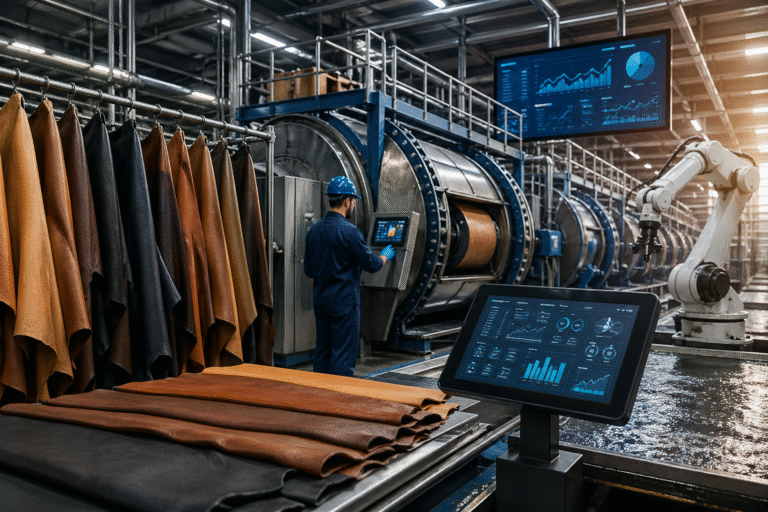
The leather manufacturing process has been digitalized, which allows tracking the temperature, pH, water consumption, and concentration of chemicals in real-time. Software and sensors give very accurate data that enables operators to adjust processes in real-time.
Digitalization is another way of making technology more predictable and controllable in leather processing.
Digital Control of Chemical Usage and Process Parameters
Digitization of leather manufacturing makes it possible to dose chemicals and water correctly. The automated control systems avoid overuse and minimize wastage.
This is cost-efficient, and it helps to comply with the environment without compromising the quality of leather.
Traceability and Quality Control Through Digital Tools
A traceability system is a system used to monitor every batch of raw hide to finished leather. Online production of leather enhances quality, records, and assurance to buyers.
Leather processing technology provides accountability and transparency in the production process.
Advanced Chemical and Process Optimization Technologies
Smart Chemical Dosing and Reduced Chemical Waste
Smart chemical dosing also uses smart chemical dosers that regulate happiness depending on the weight of the hide and the requirements of the process.
Leather processing technology reduces waste chemicals, decreases effluent, and raises sustainability. This strategy is good at controlling costs as well as environmental performance.
Technology-Driven Improvements in Tanning and Finishing
The technology in the tanning of leather has increased tanning efficiency and finishing quality. The stability and increased penetration are achieved through automated control of tanning conditions.
Precision spraying and coating systems are used in finishing, providing the final appearance and performance.
Enhancing Leather Quality Through Process Precision
One of the largest opportunities for technology in leather processing is process precision. Regulated parameters minimize defects, increase softness, and color uniformity.
The accuracy of measurement could not have been met with the old means.
Sustainable Technology in Leather Processing
Water-Saving Technologies and Closed-Loop Systems
The sustainable technology in leather processing is the technology that focuses on reducing the consumption of water.
The recycling of the water and chemicals are closed loop, thus lowering the overall consumption. The technologies also help the tanneries to meet the environmental laws and reduce the cost of business.
Energy-Efficient Machinery and Heat Recovery Systems
Energy-saving equipment and heat recovery minimize the consumption of energy. The processing technology of leather permits excellent thermal control to minimize carbon emission and improve sustainability.
Waste Reduction and Cleaner Production Technologies
Cleaner technologies of production minimize solid wastes, sludge, and other wastes. Leveraging on sustainable technology in leather processing can make tanneries responsible and productive at the same time.
Role of AI and IoT in Modern Tanneries
Predictive Maintenance and Equipment Monitoring
AI and IoT systems check the performance of equipment and anticipate failures. Leather processing technology also minimizes future maintenance and downtimes by causing predictive maintenance.
AI-Based Quality Inspection and Defect Detection
Inspection systems based on AI detect defects of surfaces, color differences, and irregularities. These databases enhance control of quality and minimize human bias.
Smart Tanneries and Connected Production Lines
The smart tanneries utilize interrelated machines and data systems. Leather processing technology allows coordinated processes, real-time reporting, and better decision-making among production lines.
Impact of Technology on Leather Quality and Consistency
Improved Uniformity, Color Control, and Finish Quality
Leather processing Technology enhances consistency between batches. Dyeing and finishing processes are automated with a uniform color, texture, and surface quality.
Reduction in Defects and Processing Errors
Automation and digital surveillance minimize the number of errors that arise from manual processing. The technology of leather-processing will allow for revealing problems early and reducing waste and rework.
Meeting Global Buyer and Compliance Requirements
International consumers are seeking uniformity, traceability, and consistency. Leather processing technology helps the tanneries to live up to their expectations.
Economic and Workforce Impact of Technology Adoption
Changing Skill Requirements in the Leather Industry
Technology in leather processing alters the employment requirements. The demand changes to prefer skilled laborers and technicians who are in a position to control automated systems instead of manual labor.
Training, Upskilling, and Workforce Adaptation
The technology adoption requires training and upskilling to be successful. The necessity of digitalization in leather production implies a lifelong learning process and adjustment.
Balancing Technology Investment and ROI
There is a need to plan for high investment costs. Tanneries have to strike a balance between the use of technology and anticipated outcomes, efficiency, and market demand.
Challenges in Adopting New Technology in Leather Processing
High Initial Investment and Infrastructure Barriers
Leather processing is a capital-intensive technology that involves the improvement of infrastructure. These costs may cause problems for smaller tanneries.
Technology Adoption Challenges in Developing Regions
Inadequate financing and skills retard adoption. Many regions are still faced with infrastructure constraints.
Resistance to Change and Knowledge Gaps
Implementation may be slowed down by resistance to new systems and technical knowledge gaps. Cultural and organizational change is necessary to make the adoption successful.
Future of Leather Processing Technology
Smart Tanneries and Fully Automated Production
The future of leather processing is the tanneries with complete automation and data basis. The processing of leather technology will keep on growing in efficiency and control.
Integration of Sustainability and Digital Innovation
Sustainability and digital innovation will be seen to collaborate in greater numbers. Environmentally conscious technologies will result in the future of leather processing.
Long-Term Outlook for Technology in Leather Processing
Automation, AI and sustainability determine the future of leather processing. Leather processing technology will continue to be one of the major sources of competitiveness and compliance.
Final Takeaway: Technology as the Future of Leather Processing
Leather processing technology is no longer an option. It is changing market efficiency, quality, sustainability, and competitiveness.
The future of leather processing will be skewed towards manufacturers who invest in innovation and change with the advancement of automation, digitalization, and smart systems.
FAQS
- What is the new technology in the leather industry?
Automation, digital monitoring, intelligent chemical dosing, artificial intelligence (AI)-based defect detection, and water saving processes are some of the new technologies in the leather industry. The contemporary tanneries employ sensors, software, and data analytics in order to enhance quality, minimize waste, and achieve efficiency. The technologies assist in achieving sustainability and ensuring a uniform quality of leather.
- What is leather technology?
Leather technology- it is a scientific and technical process of transforming raw hides into a finished leather. It involves tanning methods, chemical processes, machineries, quality control and finishing. The technology used on the leather is expected to offer durability, look, sustainability and efficiency in the manufacturing process and reduce the impact on the environment and resources wastage.
- What are the methods of processing leather?
The seeking of leather is done in various ways such as chrome tanning, vegetable tanning and synthetic tanning. This begins with curing, soaking, liming and unhairing and then tanning so as to stabilize the hide. Leather is retanned, dyed, fatliquored, dried and finished after the tanning step in order to reach the final quality and performance.
- What are the 4 grades of leather?
. The most popular four types of leather are full-grain, top-grain, genuine and bonded leather. Full-grain leather whose grain has not been refined is the best quality. Top-grain leather is somewhat re-finished but hard. Vitra employs real leather that is located in lower strata, and bonded leather is made with the help of pieces of leather mixed with glues.
- Which technique is used in leather work?
The leather work is done using the methods of cutting, stitching, edge finishing, tooling, embossing and dyeing. The leather is cut, its parts are stitched and the edges are flattened. Use of tooling, embossing, dyeing and finishing can provide decorative design, protection, color and longevity of handmade and industrial leather works.