One of the most sophisticated and technique-needing material production processes in the history of mankind is the process of leather manufacturing. Thousands of years ago, all civilizations of the world were using leather to make clothes, shelter houses, tools, and transportation.
This started as a simple survival measure but has transformed into a high specialization practice in the world involving a blend of traditional knowledge and the use of science, engineering, and environmental management.
In essence, leather production can be defined as the process of converting raw hides of animals, which are an organic substance, and can easily decompose, into a durable, flexible, and long-lasting leather.
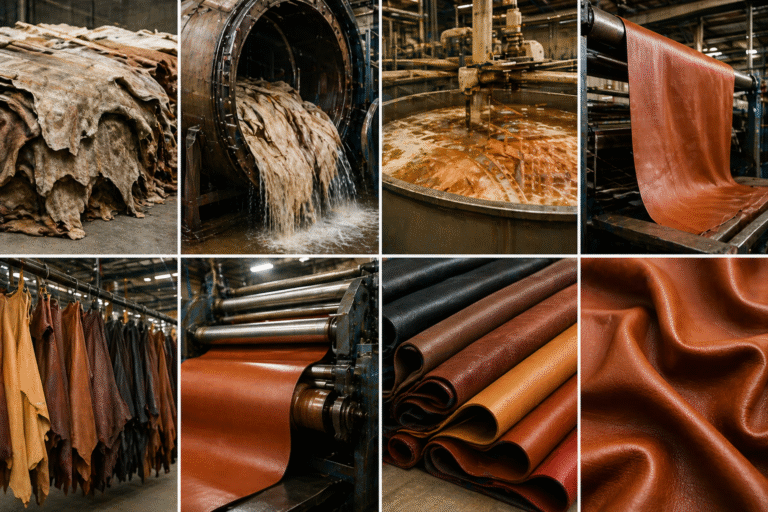
This change is not an accidental one and is not achieved at once. Rather, it is a highly managed multi-stage system with one stage preparing the hide to the next.
From curing and soaking to tanning, finishing, and grading, each process is critical in identifying the strength, look, tenderness and durability of the end product of the leather.
The manufacturers, designers, exporters, buyers and even end users must have an understanding of the leather manufacturing in order to make informed decisions with regard to the leather quality.
When they observe finished leather products, many people do not realize the complicated journey that occurs backstage. And understanding the process of leather manufacturing steps can illustrate why certain leather is stronger, why some products wear well, as well as why quality and price may be such a diverse subject.
This guide is a comprehensive explanation of the manufacturing process of the leather, which is an entire process that follows the raw hide to the finished leather. It deciphers each step of processing leather in large, easy-to-understand terms- without some unneeded jargon- so the beginner and the expert can understand the processing.
At the conclusion of this guide, you will understand how leather is made step by step, why every stage is important, and how the leather of high quality is produced in various regions and sectors of the world.
What Is Leather Manufacturing? A Complete Overview
Leather Manufacturing Meaning and Industry Definition
Leather manufacturing is the entire industrial and technical process with the help of which raw animal hides are turned into stable, strong, and practical leather. In their natural form, raw hides are organic substances, which start to decompose within hours when they are not treated.
The leather production is to ensure that this is not decayed at the expense of the natural strength, flexibility, and feel of the hide. The hide is then transformed into a substance that can serve over decades without losing its structural integrity using an array of closely monitored treatments.
Mechanically, chemically and physically, leather production is a process that includes various activities at the industry level. These activities collaborate in stabilizing the collagen fibers of the hide which makes leather strong and elastic.
Tanning, especially, is at the center stage as it changes the protein structure of the hide in such a manner that it is no longer vulnerable to heat, moisture and bacteria. In the absence of such transformation, leather would be too weak and not fit to be used anywhere in a practical context.
The leather manufacturing process is developed to make a variety of leather types, which are customized to be used in specific applications. The leather in footwear must be durable and flexible, furniture leather must be soft and resistant to wear, and automobile leather must be uniform and be able to perform over time at different temperatures.
Manufacturers can control these variations in thickness, texture, color, softness and strength by modulating chemicals, processing time and finishing techniques.
The leather manufacturing in the contemporary industry is also directly related to quality control, environmental management and global trade.
The large tanneries are regulated with high standards with a good consistency, safety and environmental regulations.
Subsequently, leather production nowadays is not merely the production of leather, but a combination of performance, looks, sustainability and market demands in a very competitive global sector.
Why Leather Manufacturing Is a Multi-Stage Process
The process of leather production could not be accomplished at once since raw animal hides are biologically unstable and complex in their structure. Hides, in their natural state are covered with hair, fat, flesh, moisture, bacteria and organic matter that render them impractical for long term use. Every step in the manufacturing of leather has a certain issue to solve in the hide, and the process is continued until it becomes a stable and usable substance.
The fact that the manufacturing of leather is a multi-stage process enables the cleaning, softening, stabilizing, strengthening, and refining of the hide to occur in a controlled way.
The initial stages are aimed at preservation and rehydration, when it is necessary to make sure that the hide does not spoil and can be processed in the same way. Subsequent stages alter the internal fiber, enhance flexibility and fix durability.
Last stages are used to improve the appearance, feel, and performance depending on how the leather is to be used.
Consistency is another reason why the manufacture of leather needs several steps. Raw hides are diverse in terms of their thickness, size and quality depending on the animal, the climate and the manner in which it was handled.
The processing in steps will enable the manufacturers to correct irregularities, eliminate defects and standardize the material properties. This will guarantee that completed leather is of predictable quality, particularly in industrial and commercial use.
Also, the various processes of transforming the leather assist in retaining the natural properties of leather and enhancing its functionality. Rather than losing the identity of the hide, the process actually improves its natural grain, strength and texture.
Through its ability to disseminate change through multiple staged processes, the leather processing methodology offers a balance between the beauty of nature and performance of engineering that could not have been achieved under a one-stage process.
Difference Between Leather Manufacturing and Leather Processing
Leather manufacturing and leather processing are used interchangeably though they do not interchangeably mean the same thing.
Leather processing can be defined as the separate or special steps in the production cycle of the entire process, e.g. soaking, tanning, dyeing, or finishing. These processes explain how the hide will be when it will be at a given point at that time.
Leather manufacturing on the other hand is the entire lifecycle of leather manufacturing- starting with the preservation of a raw hide, up to the stage where the finished leather is graded, inspected and a ready product is ready to venture into the market.
It consists of all the technical, chemical, mechanical, and quality-control operations of converting raw hides into commercially useful leather.
This difference is valuable to know since the process of preparing leather is just a part of the larger industry.
As an example, tanning is a very important stage in the processing, yet, unless the leather is properly preserved prior to tanning or after tanning, the leather still would not be to the desired quality. The production of leather makes sure that all processing processes are integrated into one system.
Leather processing, in basic terms, is concerned with the process of transformation of the hide to the changes that are involved, whereas leather manufacturing has its concern on the transformation process as a whole; i.e how the whole process can be handled.
The manufacturing involves planning, sequencing, quality checks, environmental management and market preparedness. Processing falls under production- but production is the entire organised process of leather; raw hide to finished product.
Raw Material Selection in Leather Manufacturing
Types of Animal Hides Used in Leather Manufacturing
The manufacturing process of leather depends on the animal hides as raw material and the type of hide chosen is important in deciding the quality of the end leather.
Cattle, buffalo, sheep, goats and in some parts camels are used as the most common hides in the production of leather.
Every kind of hide possesses its own set of physical features that affect the thickness, strength, structure of the grain, flexibility and the products to which it is useful.
The most popular hides utilized in leather production in the world are the cow hides because they are available, have a moderate thickness and a good fiber structure. They are smooth grained and durable and can be used in footwear and bags, upholstery applications and in car interiors.
Buffalo hides are heavier and tougher than cow hides, and have a very characteristically defined grain.
Their density is high in fiber which ensures their usage in heavy-duty leather products like belts, saddles, industrial gloves, and strong footwear.
Hides of sheep are inherently smoother and, being thinner, have thinner fibers and more fat. All these features render sheep leather appropriate as garments and lining material and fashion accessories where comfort and softness are the main focus.
Goat hides are in between soft and strong. They can withstand wear longer than the sheep hides but are still flexible and hence they are used in handbags, wallets, and small items of leather.
Camel hides are also less popular, and they are worn in the areas where camels are widely common. Camel leather is associated with its power, ability to endure extreme weather conditions and particular grain structure.
Traditional products, travel products, and specialty leather are some of the traditional products that may be used in leather manufacturing by using camel hides.
One of the earliest and most crucial choices in leather production is the animal hides. It has a direct impact on processing techniques, use of chemical, finishing and performance outputs of the end product of leather.
How Hide Quality Affects the Leather Manufacturing Process
The quality of the skin hinges directly and permanently on the whole process of leather production.
Good quality hides are evenly thick, have very little or no damage on their surfaces, and have a good fiber structure, hence can undergo processing without losing a lot. These hides present more useful leather, less wastage and a stronger and more aesthetic finished product.
In cases with high quality of hides, curing, soaking, and liming are performed with ease in their early stages.
The chemicals absorb evenly, the fibers open evenly and the tan agents adhere evenly. It creates increased control during the tanning, dyeing, and finishing processes to create leather which will act predictably regarding strength, flexibility, and appearance.
Hides of poor quality pose a challenge throughout the process of leather production. Defects add to the cost of trimming in terms of losses, add to the cost of chemicals used, and add to the cost of additional processing to cover up defects.
These hides usually lead to the uneven tan, uneven absorption of color and weaker fibres. This can lead to a decrease in grade where the end product is of a lower grade hence decreasing its value in the market.
Quality of hides also impacts on the cost of production and sustainability. More efficient and an environmentally responsible leather manufacturing process it is because better hides need fewer corrective treatments and produce less waste. This is the reason why seasoned manufacturers spend a lot of money in getting quality hides and enhancing animal handling procedures at the farm level.
Common Defects Found in Raw Hides Before Processing
Raw hides are usually subject to natural and handling-related flaws which influence their suitability in the production of leathers. Scarring is one of the most widespread defects and it may be caused by injuries, scratches by thorns or harsh environment.
These scars also interfere with the surface of the grain, and minimize the hole available in the hide.
Bites by ticks and parasitic damages are typical particularly in hot and damp areas. These defects are in the form of small pits or holes on the surface of the hide and may have a major impact on smoothness of the grain.
Hot iron identification produces branding marks that are permanent, and cause disfigurement to large areas of the hide and are one of the most devaluing characteristics of leather production.
Flay cuts are made when the knives cut too deep into the hide during improper skinning. Such cuts damage the fiber structure and they frequently need to be trimmed down, lowering yield.
Wrinkles and stretchmarks that appear especially around the neck and belly areas impact uniformity and make finishing difficult.
All these defects affect the leather production processes that must be done to correct, cover, or reduce the noticeable defects.
Although finishing methods can minimize some blemishes, most of them are permanent and prevent the grading and use of the hide.
That is why defect identification and quality measurement in early stages is a vital component of a successful leather production.
Step 1 – Curing and Preservation of Raw Hides
Why Raw Hides Must Be Preserved Immediately
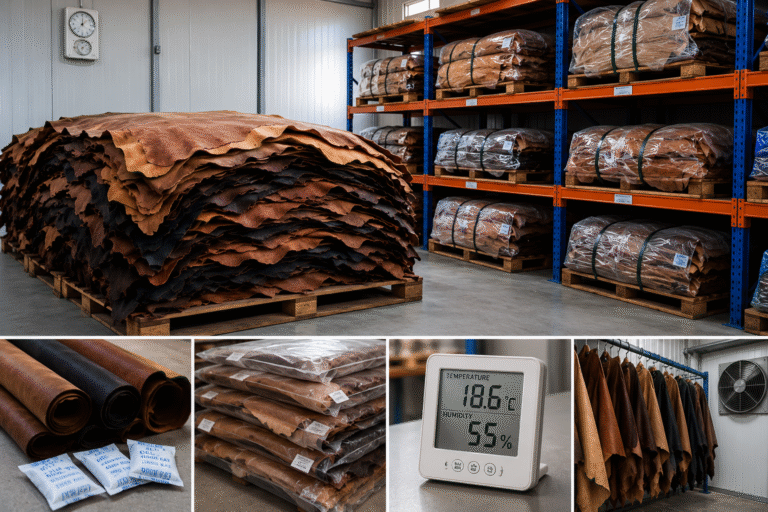
Raw hides start to decompose in a few hours when they are not treated. The first important step of leather manufacturing is preservation that will prevent bacteriology and structural damage. In the absence of a proper curing, the whole leather manufacturing process would fail.
Salting Method in Leather Manufacturing
Salting eliminates the moisture and acts as an anti-bacterial. It is among the most common methods of preserving leather that is used in the manufacturing of leather globally, particularly when hides have to be transported to a long distance.
Chilling, Drying, and Temporary Storage Methods
Chilling and drying retard the process of decomposition and it preserves hides on a short-term basis. These modes are well planned depending on the climate, time of transportation and processing in the leather manufacture process.
How Improper Preservation Affects Final Leather Quality
Poor curing will result in slipping hair, bad smell, poor fibers and poor tan. These complications permanently decrease the quality of leather and the market price.
Step 2 – Soaking and Rehydration of Raw Hides
Purpose of Soaking in the Leather Manufacturing Process
The curing removes water lost in the process of drying and also removes salt, dirt, blood, and impurities. The step brings the hide back to workable condition and makes it ready to undergo additional treatment procedures.
Chemicals and Water Treatment Used During Soaking
Wetting agents, bactericides, and surfactants are meant to be introduced into the water so that it can penetrate and be clean. Stability in leather manufacturing would require water quality management.
Removing Dirt, Salt, and Blood from Raw Hides
Proper soaking will produce uniform softness, and prevents the occurrence of chemical imbalance in downstream processing of leather.
Step 3 – Liming and Unhairing Process
Why Liming Is Necessary in Leather Manufacturing
Liming removes the hair and de-rigidizes the fiber structure of the hide. This enables tanning agents to seep in deeper when the leather manufacturing process gets to later stages.
Hair Removal and Opening of Hide Fibers
Calcium hydroxide and sulfides destroy hair roots, as well as relax the fibers. This procedure vastly modifies the structure and the thickness of hides.
Environmental Impact of Liming and Waste Management
The production of liming results in a lot of waste and as such, wastewater treatment and chemical recovery have become a significant sustainability issue in contemporary leather production.
Step 4 – Fleshing, Splitting, and Trimming
Removing Excess Flesh and Fat from Hides
Fleshing using machines can clean and enhance consistency in hides and remove undesirable tissue.
Splitting Hides to Control Leather Thickness
Teenage divides skin into sheets. Thickness is a crucial issue in product performance and cost-effectiveness during leather production processes.
Preparing Hides for the Tanning Stage
Clipping gets rid of uneven fringes and preconditions even tan on hides.
Step 5 – Deliming, Bating, and Pickling
Adjusting pH Levels Before Tanning
Deliming counteracts liming to alkalinity, in order to stop fiber damage and secure smooth tanning responses.
Enzymatic Softening and Fiber Preparation
Hide softening and grain smoothness in bating enzymes is an important step in the manufacture of leather, step by step.
Why Pickling Is Critical for Chrome Tanning
Pickling reduces the pH, fixes hides to be tanned using chrome resulting in enhanced penetration and fixation.
Step 6 – Tanning Process in Leather Manufacturing
Purpose of Tanning in Leather Manufacturing
Tanning fixes the collagen fibers to give raw hide non-decomposing leather. It is the most characteristic phase in the process of leather manufacturing.
Chrome Tanning Process Explained
Chrome tanning involves the use of chromium salts to manufacture soft, supple and waterproof leather. It is quick and extensively applied in manufacturing leather across the world.
Vegetable Tanning Process Explained
Vegetable tanning involves the use of plant tanning. It is slower producing firm leather with natural aging characteristics.
Chemical vs Natural Tanning Methods
The two methods are not without merits. Chrome tanning is mass produced and vegetable tanning is used in most traditional crafts.
How Tanning Converts Raw Hide into Stable Leather
Permanent alterations of protein structure through tanning make the structure resistant to disintegration.
Step 7 – Wet Blue Stage Explained
This stage entails the transfer of fresh perspectives on work and organizational behavior
What Is Wet Blue Leather in Manufacturing
Wet blue leather is a semi-processed leather, which is chrome-tanned. It is a decisive point of raw hide to finished leather process.
Wet Blue Leather Meaning and Characteristics
Blue-gray, stable, flexible and wet blue leather is ready to proceed with additional processing.
Why Wet Blue Leather Is Traded Globally
Blue leather that is wet and dry is more transportable and easy to store thus a significant trade commodity all over the world.
Wet Blue vs Crust Leather Differences
The crust leather is dried and partially finished, the wet blue only kept moist and untreated.
Step 8 – Retanning, Dyeing, and Fatliquoring
Purpose of Retanning in Leather Manufacturing
Refining of leather to create softness, fullness and tightness of the grain is done through retanning.
Dyeing Leather for Color and Uniformity
Dying brings uniformity of colour and appeals.
Fatliquoring for Softness and Flexibility
Fatliquoring is a lubricant that makes the fibers not to be stiff and crack.
How These Steps Affect Final Leather Performance
These therapies define comfort, longevity and application aptness.
Step 9 – Drying and Conditioning of Leather
Common Drying Methods Used in Tanneries
Depending on the type of leather, it is air dried, vacuum dried and even tortoise dried.
Controlling Moisture to Prevent Cracking
Wetness inhibits the destruction of fibers and brittle state.
Conditioning Leather for Further Finishing
Conditioning is a preparation of a leather to surface treatment.
Step 10 – Finishing Process in Leather Manufacturing
Surface Coating, Buffing, and Embossing
Finishing enhances the looks, texture and wear resistance.
Natural vs Corrected Grain Finishes
Authenticity is preserved in natural grain whereas flaws are concealed in corrected grain.
How Finishing Impacts Appearance and Durability
Direct completion has an impact on lifespan and market value.
Leather Grading and Quality Control
How Leather Is Graded After Manufacturing
The grading of leather is done on the basis of the surface, defects, and consistency.
A, B, C & Select Leather Grades Explained
Grades with high grades contain less defects and have more usable area.
Quality Checks Before Market Distribution
The last checks are to ascertain adherence to quality.
Environmental Impact of Leather Manufacturing
Water Usage and Wastewater Treatment
The leather Industry is a big consumer of water, and thus it needs sophisticated treatment systems.
Chemical Management and Sustainability Challenges
Handling and disposal of chemicals are still a significant issue of concern.
Modern Eco-Friendly Practices in Leather Manufacturing
Sustainability is being enhanced by cleaner production techniques, as well as recycling technology.
Global Leather Manufacturing Industry Overview
Major Leather Manufacturing Countries
The world production is dominated by China, India, Pakistan, Italy, Brazil, and Bangladesh.
Role of Climate and Region in Leather Manufacturing
Climate influences the level of hide quality, preservation and defects.
Pakistan vs Other Countries in Leather Manufacturing
Pakistan has a reputation of having very good hides whereas Europe is in the lead in luxury leather.
Uses of Finished Leather in Different Industries
Leather Manufacturing for Footwear Industry
The biggest part of leather manufacturing in the world is in footwear.
Leather Manufacturing for Bags and Accessories
Bags and accessories need to be flexible, beautiful and durable.
Furniture, Automotive, and Industrial Leather Uses
The leather needed in automotive and furniture industries is high performance and constant.
Common Challenges in Leather Manufacturing
Defects, Waste, and Cost Management
Flaws augment waste and decrease profitability.
Environmental Regulations and Compliance
Tougher laws drive up innovation and compliance expenses.
Quality Consistency Across Production Batches
It is always a challenge to maintain consistency in large-scale manufacturing of leather.
Future of Leather Manufacturing
Sustainable and Bio-Based Leather Innovations
Substitutes and processes that are environmentally friendly are becoming popular.
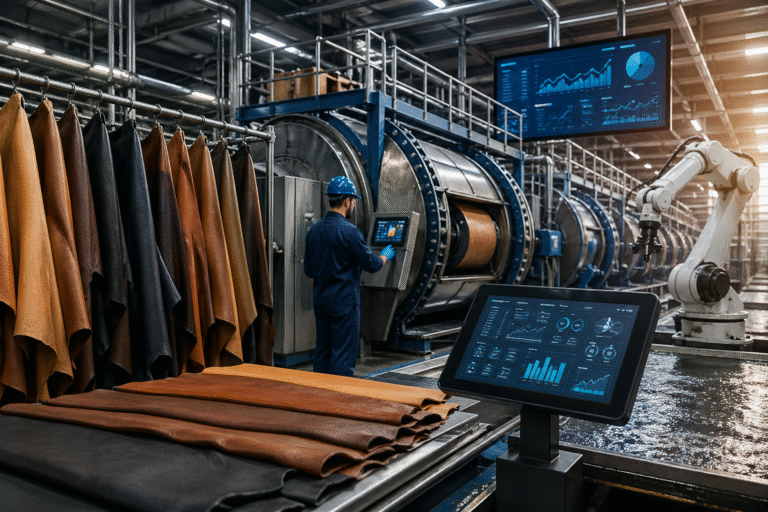
Automation and Technology in Tanneries
Robotization enhances effectiveness and predictability.
Changing Global Demand and Market Trends
The demand is moving towards sustainable and traceable leather.
Final Takeaway: Understanding Leather Manufacturing from Start to Finish
The production of leather is much more than an industrial activity – it is a well-coordinated process in which biology, chemistry, craftsmanship, and technology converge.
Even after an animal hide has been taken off, each course of action taken in the steps of leather manufacturing will directly affect the quality, durability, and performance of the finished product.
Cures will prevent decay, soaks will bring back the flexibility, tanning will fix fibers and finishing will determine the look and use. Any omission or poor handling of any one of the stages will irreversibly impair the leather.
After learning the whole story of leather manufacturing it is evident that one cannot conclude the quality of leather by looking at it.
The choice of hides, preservation, type of tanning, conditions of processing, finishing and all these factors lead to the final result. This is the reason that two similar looking leather products may act in completely different ways after a period of time.
To the manufacturers and suppliers, the stages of leather processing would enable them to regulate quality, minimize waste and conform to the environmental regulation.
To the buyers and designers, it is wise to learn the step-by-step process of making leather and make wiser choices in sourcing and design of products.
This knowledge is even useful to the consumers who learn how to recognize good leather which is well made and take care of it.
Finally, leather manufacturing is a process of change, starting with raw hide to final leather whereby skill, accuracy, and accountability are important at each stage.
When properly done, it leads to a material that is powerful, versatile, perennial, and one that can endure through the decades.
This trip does not only make people appreciate leather products, but also emphasizes the relevance of quality products, and sustainable leather production in the modern world industry.
FAQs
- What are the methods of processing leather?
Leather has a number of ways of being processed and each of them is used to achieve a different purpose. The most popular ways are chrome tanning, vegetable tanning and synthetic or chemical tanning. Tanning with chrome is quick and results in soft leather whereas tanning with vegetables is slow and involves plant tannins. Other processing procedures are retanning, dyeing, fatliquoring, drying and finishing which are used to complete the manufacturing process of leather.
- What is the leather finishing process?
The last phase in the manufacturing of leather is its finishing that enhances both look, feel and uses. It involves drying, buffing, coating, embossing and polishing leather surfaces. The process of finishing may add colour, smoothness, resistance to water and long life. The process is also useful in concealing small imperfections and in making leather ready to be used in particular applications like shoes, luggage, furniture or car interior.
- Is 100% leather real leather?
Yes, one hundred percent leather implies that the product is not made of artificial leather, but of animal hide. Nevertheless, it is not necessarily that the leather is of good quality. Leather can be full-grain, top-grain or split leather, and they all can be called 100 percent leather. It is the quality of the leather that is processed, finished and graded that counts and not the percentage claim.
- Who are the top 3 producers of leather?
China, India, and Brazil are the leading manufacturers of leather in the world. China is the biggest producer of leather in great numbers and India is the raw hide producer as well as the finished leather goods producer and Brazil is a large producer of good quality cattle hides. Italy, Pakistan and Bangladesh are also the other players of significant industry as they specialize in other forms of leather and processing capacities.
- What is the formula for leather?
There is no standard chemical formula of leather since it is a natural product that is a product of animal skin. It is primarily made of collagen, a protein fiber structure, which is present in the skin. In leather production, collagen fibers are chemically bonded with tanning agents in order to stabilize them. The specific chemical formula that is used is based on the tanning technique, chrome tanning or vegetable tanning, and the finishing effects provided.