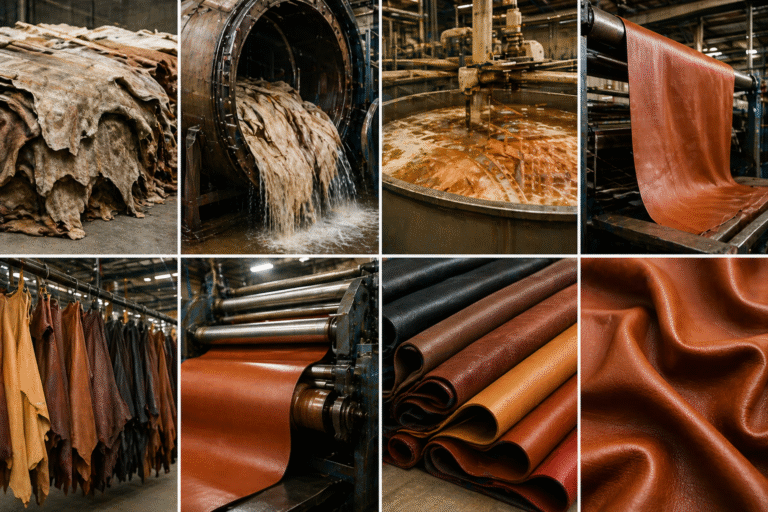
Leather tanning is one of the most important processes that convert the raw animal hides into strong, supple and useful leather. Hides would spoil soon and could not be used in the long run without tanning.
leather chemical tanning vs natural tanning, the tanning technique has a direct influence on the leather strength, softness, appearance, environmental impact and end use suitability.
The modern production of leather involves two main methods of tanning namely, leather chemical tanning vs natural tanning. All approaches possess their peculiarities, advantages and drawbacks.
Knowledge of leather chemical tanning vs natural tanning assists buyers, manufacturers and designers to select the appropriate leather in foot wear, bags, upholstery, and industrial use.
Understanding the Leather Chemical Tanning Process
What Is Chemical Tanning in Leather Processing?
The synthetic or mineral-based chemicals are applied in the leather chemical tanning process to stabilize the hide fibers. This process transforms the protein structure of raw hides to be impervious to decay, heat, and moisture.
The reason behind the widespread use of chemical tanning is speed, consistency, and scalability, which predominates in the global leather production.
Chrome Tanning Explained for Leather
The most widespread type of chemical tanning is chrome tanning. In the tanning leather comparison of chrome tanning and vegetable tanning, the chrome tanning involves the use of chromium salts to create soft and flexible leather that is of a high status of durability.
Chrome-tanned leather is usually applied in the automobile industries, footwear and in upholstery.
Other Chemical Tanning Methods Used in Tanneries
Other than tanning with chrome, tanneries also apply aldehyde tanning, synthetic tanning agents, and combination tanning. These types of leather tanning methods enable the manufactures to modify the leather properties according to the performance and compliance demand.
Understanding the Natural Leather Tanning Process
What Is Natural Leather Tanning?
In the natural tanning procedure, tanning is based on plant tannins that were obtained by extracting the barks, leaves, and roots. It is a centuries-old practice that produces leather that has a hard structure and a natural look.
Natural tan is not using synthetic chemicals, which are attractive to the traditional and ecological markets.
Vegetable Tanning Explained
The most popular natural way of tanning is vegetable tanning. In regard to chrome tanning vs vegetable tanning leather, vegetable tanning results in a stiffer leather that gets nice with aging. It is usually applied in belts, saddles, wallets and handmade leather products.
Traditional and Modern Natural Tanning Techniques
In traditional vegetable tanning, the tanning process can take a long time to complete whereas the contemporary natural tanning processes employ better extraction and controlled operation.
These developments increase the natural leather tanning process while conserving the traditional features.
Leather Chemical Tanning vs Natural Tanning: Processing Differences
Speed, Efficiency, and Scalability
Speed is a significant difference between leather chemical tanning vs natural tanning. The natural tan can take weeks whereas chemical tanning can be done within days. This increases the mass-produced chemical tanning.
Resource Use and Production Time
The chemical tanning process of leather takes less processing days and is dependent on controlled chemical inputs. The tanning process of natural leather takes more time and space as compared to the use of renewable materials.
Consistency and Control in Leather Results
Chemical tanning has more consistency and control as far as leather properties are concerned. Natural tan can vary batch to batch, which is highly sought after in the artisanal market, but that cannot be easily done in factories.
Leather Properties Comparison
Softness, Flexibility, and Feel
The chemical tanning process on leather and the natural tanning process leads to varying textures. The chemical tanning gives a softer and more flexible leather whereas natural tanning gives a firmer leather with a structured feel.
Durability, Strength, and Aging
Leather that is stained with chrome is more resistant to moisture and heat, and leather that is stained with vegetable tanning acquires a patina with time. The two approaches are durable, however, there is a big difference in the behavior of aging.
Color Range and Finish Compatibility
Chemical tan encourages extensive color spectrum and contemporary finishes. Natural tanning does not offer a variety of colors but gives a natural look that is cherished in high quality artisanship.
Environmental Impact of Leather Tanning
Environmental Impact of Chemical Leather Tanning
The ecological effects of leather tanning are commonly linked to chemical tanning because of the wastage of water through the product of wastewater, chromium leftovers, and energy consumption. The contemporary tanneries reduce such effects using treatment systems and recovery technologies.
Environmental Impact of Natural Leather Tanning
Plant-based tannins are perceived to be more eco-friendly because of the natural leather tanning process. It however needs a lot of water and time that also makes an environmental impact.
Waste, Water, and Emissions Comparison
These two processes cause wastes and use of water. The difference between the environmental effect of leather tanning and the tanning type is not as significant as the tannery practices.
Pros and Cons of Chemical Leather Tanning
Advantages of Chemical Tanning
Chemical tanning is fast, consistent in quality, soft and very durable. It favors mass production as well as uniformity between industries.
Disadvantages of Chemical Tanning
Issues of concern are chemical handling, wastewater treatment, and regulation issues. Chemical tanning may bring about environmental risk, unless effective controls are in place.
Common Uses of Chemically Tanned Leather
Footwear, automotive interiors, furniture, garments and accessories are widely produced using chemically tanned leather because it is flexible and strong.
Pros and Cons of Natural Leather Tanning
Advantages of Natural Tanning
Natural tanning generates leather of rich character, natural look and extended patina. It targets the artisanal arts and upscale market.
Disadvantages of Natural Tanning
The common challenges include long processing times, color choices and high costs. It is also not as scalable as compared to chemicals.
Common Uses of Naturally Tanned Leather
Belts, saddles, wallets, artisanal bags, and heritage products are made with leather that is naturally tan and in which aesthetics and the process of aging are known to be the most important.
Choosing the Right Tanning Method for Leather Products
Best Method for Footwear, Bags, and Upholstery
Chemical tanning is also used in footwear and upholstery because of flexibility and durability. Bags and accessories can apply either of the methods based on design and performance requirements.
Cost, Performance, and Sustainability Considerations
A decision regarding leather chemical tanning vs natural tanning has to be made by weighing up the cost, durability, appearance and environmental expectations.
Buyer and Manufacturer Decision Factors
The choice of the tanning methods is determined by end-use, compliance, positioning the product in the market, and the scale of production.
Future Trends in Leather Tanning Methods
Cleaner Chemical Tanning Technologies
Developments in leather tanning are minimizing the environmental effects of leather tanning with chrome recovery, low salt systems and cleaner chemicals.
Growth of Sustainable and Bio-Based Tanning
There is an increase in bio-based and hybrid tanning techniques that merge the efforts of chemical and natural techniques.
Regulations Shaping Leather Tanning
Stricter environmental policies are still affecting tanning preferences and adoption of technology in the world.
Final Takeaway: Leather Chemical Tanning vs Natural Tanning
There is no question of leather chemical tanning vs natural tanning but of the appropriate style to use when dealing with certain products and markets.
Both tanning approaches have their own benefits and knowledge of the differences guarantees improved sourcing, performance and sustainability results.
FAQs
- How to tan leather without chemicals?
Tanning of leather can be done without using synthetics and most tanning used is vegetable tanning. It is done with the help of tannins of trees, leaves, or roots, which are tannins of plants. The hide is saturated over weeks with tannin-rich solutions and it is the tannin that is responsible to stabilize the fibers and deterioration and result in firm and durable leather.
- Is tanning leather physical or chemical?
In the case of natural tanning, leather tanning involves the use of a chemical process, although natural processes are employed. Tanning modifies the collagen fiber chemical structure in the hide rendering them stable, and decomposing them tough. The process is assisted by physical activities such as soaking and agitation but the transformation is chemical.
- What is natural tanned leather?
Natural tanned leather is a type of leather, which has been tanned with the use of plant tanning agents rather than chemicals. It is also available in vegetable tanning and gives leather a hard feel, like natural look and power to age and acquire a deep patina. This leather is commonly applied in belts, saddles and hand made products.
- What is the lowest quality of leather called?
The poorest grade of leather is also commonly known as bonded leather. It is manufactured using spare leather fibers that are combined with the adhesives and bonded into sheets. Bonded leather has minimal amounts of actual leather and is not durable, strong or has characteristics of aging as opposed to genuine or full-grain leather.
- What chemicals are used to tan leather?
Some of the common substances that were applied to tan leather are chromium salts (chrome tanning), aldehydes, synthetic tanning agents, and vegetable tannins. Tanning chemicals of choice are chrome tanning whose speed and durability make it the most popular. Controlled acids, salts and stabilizers are also used in the process of tanning in modern tanneries.