The global leather market 2025 is going into a period of significant change. Since the pandemic, supply chain instability, and changing consumer behavior have disrupted the industry, the leather industry itself is setting a new set of priorities.
The footwear, automotive, furniture, and fashion demand is also reviving, but the manner in which leather is manufactured, traded, and priced is changing at an extremely rapid pace. The global leather market 2025 is altering its proceedings because of the demand of sustainability, rising compliance expenses, and alteration of the geopolitical trade.
The information regarding the global leather market 2025 is no longer a luxury of the manufacturers, exporters, buyers and investors. Price volatility, environmental regulations and regional production strengths are the factors that are currently affecting the current sourcing and investment decisions.
This guide gives an overall perspective of the trends of the global leather market 2025, the price of leather in the market, the most important leather-producing countries, and the market of Pakistan in the global leather trade. It is meant to give the businesses a clear and confident guide on how to navigate through the changing world of leather.
Overview of the Global Leather Market in 2025
Global Leather Market Size and Growth Outlook
The global leather market 2025 will also be projected to keep on growing steadily after undergoing an uncertain period. New activity is being led by recovery in consumer demand, especially in footwear and automotive interiors.
The growing economies are also contributing to growth in volume, and the developed markets are emphasizing on value added and certified leather products. The prognosis of the global leather business implies steady, but mild growth, and other seemingly good growth is the growth in the industries dealing with processed and finished leather products, and not only the raw hides.
Key Segments: Raw Leather, Wet Blue, Finished Leather
The world leather market comprises raw leather, wet blue, and finished leather. The base of the industry is still raw leather, particularly in the livestock-rich countries. Wet blue is a trade-able wet-intermediate product that is processed internationally.
Finished leather is the most important value market, which is focused on fashion, luxury goods, automotive, and furniture. Value creation in the global leather market 2025 is moving towards finished leather and specialized use more.
Demand Drivers Across Footwear, Automotive, Furniture, Fashion
The biggest consumer of leather in the world is footwear, automotive interiors, and furniture. In its high-end segments, fashion and accessories will be value-added. The market trends in the international leather market show that there is an increasing demand for durable, traceable, and sustainably produced leather in all these industries.
Global Leather Market Trends Shaping 2025
Sustainability and Environmental Regulations
One of the strongest trends in the leather market throughout the entire world is sustainability. The international brands and their governments are also enforcing stricter environmental regulations, which consist of wastewater cleansing, chemicals, emissions, and traceability.
Sustainable practices are turning into a competitive advantage rather than a liability, a factor that is raising the costs of compliance. The global leather market 2025 is shifting towards using sustainability as a criterion in sourcing and trade relations.
Shift Toward Value-Added and Finished Leather
Raw hides are being processed and finished, and countries that used to be raw hides exporters are investing in them. This change gives the exporters the capacity to gain a better value as well as minimize the reliance on the prices of the raw materials. The international leather market is highly biased towards the countries that upscale the value chain.
Technology, Automation, and Digitalization in Tanneries
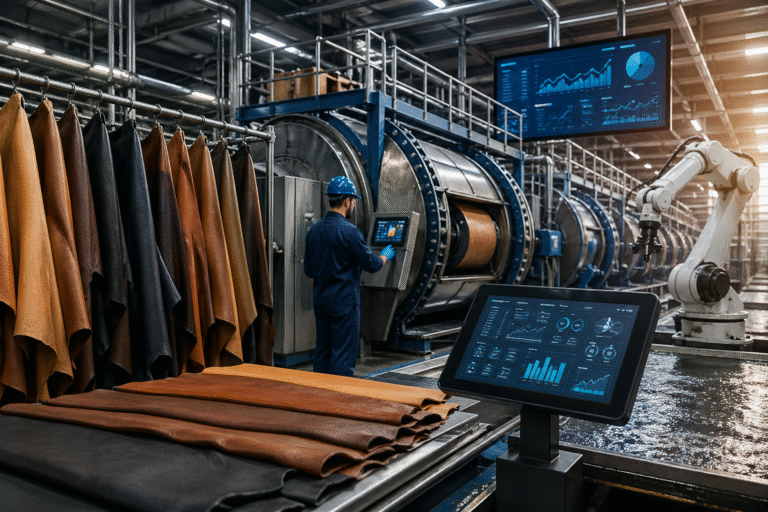
The process of leather manufacture is being changed by automation, digital control, and quality control based on data. The technology minimizes waste, enhances consistency, and facilitates compliance. This is necessary to compete with the global leather market 2025.
Leather Market Prices and Cost Dynamics
Raw Leather Price Trends in 2024–2025
The prices of the leather markets have been volatile because of the disruptions in the supply, inflation, and the non-uniformity of demand recovery. The price of raw leathers is affected by the availability of livestock, the seasonal slaughter, and the exportation. The global leather market 2025 is stable in terms of price, but it is vulnerable to external shocks.
Impact of Supply, Climate, and Livestock Cycles
In most areas, climate change is influencing livestock health and the quality of the hide. Rawhide is affected by droughts, floods, and disease outbreaks. These are directly involved with the prices of leather markets and long-term supply planning.
How Energy, Labor, and Compliance Costs Affect Prices
The prices of energy, lack of skilled labor, and environmental compliance highly affect the prices of leather. Strictly regulated tanneries are also more expensive, which is progressively transferred to consumers. These dynamics are very important in analyzing the leather trade.
Leading Leather Producing and Exporting Countries
Brazil: Raw Hide and Semi-Processed Leather Leader
Brazil has continued to be amongst the largest leather-producing countries owing to its mammoth livestock foundation. It primarily controls the exports of raw hide and semi-processed leather, which are used to provide tanneries in other nations. The power of Brazil consists of size, predictability, and reliability of supply.
Italy: High-Value Finished Leather and Luxury Focus
Italy is the leader in the high value finished leather and luxury uses. Its design, finishing and compliance skills make it the leading in export value ranking. The future of Italy and leather in the world market is characterized by quality, not quantity.
China & India: Processing Scale and Manufacturing Power
China and India have high processing capacity and high domestic manufacturing industries. Both of them are large exporters and importers of leather. The global market trends on leather are still affected by their size and cost advantages.
Regional Leather Market Analysis
Asia-Pacific Leather Market Growth
The Asia-Pacific region continues to be the fastest-growing region in the global leather market 2025. Growth is triggered by increased consumption, production, and export, particularly in South and Southeast Asia.
Europe’s Focus on Quality, Compliance, and Sustainability
The European markets demand certified and sustainable leather. Although volume growth is low, the Europeans are the market leaders in the field of innovation, traceability, and regulatory standards, which form the global perspective of the leather industry.
Americas and Emerging African Markets
The Americas are still doing well in the production of rawhide, whereas Africa is taking the direction to be a sourcing region in the future. The analysis of the leather trade may take a new form in the next few years due to investment in infrastructure and processing.
Pakistan Leather Market: Current Position and Capabilities
Overview of the Pakistan Leather Market
Pakistan’s leather market is a major producer of raw leather and semi-processed products in the world market. Having a good livestock foundation, Pakistan is a significant part of regional and world trade.
Raw Leather Availability and Processing Strength
Pakistan has rich cow, buffalo, goats and sheep hides. Its processing industry is also strong, especially in wet blue and crust leather. This provides the Pakistani leather market with a cost and availability advantage.
Key Export Markets and Trade Relationships
Most of the export destinations include China, Italy, and Vietnam, among other manufacturing hubs in Asia. These ties enhance the process of integrating Pakistan into the global leather market 2025.
Pakistan’s Role in the Global Leather Trade
Competitive Advantages of Pakistani Leather
Pakistani leather has a good standing in the world of leather trade because it has natural strength, thickness, and good processing performance.
The nation enjoys a good livestock base, especially buffalo and cow hide, which is characterized by a thick fibrous structure and high cutting yield. These properties render Pakistani leather particularly fitting for the soles of the footwear, upholstery, belts, and heavy-duty applications.
The other major strength is competitiveness in terms of cost. In Pakistan, labor, the availability of raw materials, and the cost of processing enable exporters to be able to price competitively without having to largely compromise on quality.
Moreover, the Pakistani suppliers are able to supply a constant annual supply, which is very important to the international manufacturers who depend on constant production timelines. This quality, availability, and price equilibrium has been serving to bolster the competitiveness of Pakistan in the global leather market 2025.
Comparison With India, Brazil, and Africa
Comparing it to other global sourcing regions, Pakistan is in the middle ground, which is attractive to international consumers.
India has a high volume production and a well-developed finished leather industry, but the cost of compliance and labor has risen, hence raising the prices.
Brazil is one of the leading leather-producing countries of raw hides, as it has a huge livestock base, but it is more involved in raw and semi-finished exports as opposed to a flexible adaptation.
Competition based on price among African countries is intense, but poor quality, a limited infrastructure, and complicated logistics make these countries less reliable to the large purchaser.
Pakistan, in its turn, has a more competitive offer, but with more consistency than most of the African suppliers, a competitive price compared to Europe or parts of India, and processing capacity adequate to take up the wet blue and crust leather export. This put Pakistan in a strategic position in the analysis of the leather trade.
Pakistan’s Position in Global Leather Trade Analysis
In the analysis of the leather trade in the world, Pakistan has been accredited as a reliable source of leather that can be moved up the value chain.
Although historically they were dealing in raw leather and semi-processed leather, Pakistan can diversify into finished and specialty leather sectors.
Trade links with China, Italy, Vietnam, and the Middle East enhance the position of Pakistan as a source of supply between the livestock-producing areas and the manufacturing centers with high consumption.
As Pakistan further invests in sustainability, compliance, and finishing technology, its contribution in the global leather market 2025 may increase its levels beyond volume-based export into higher-value trade.
Global Leather Trade Analysis and Supply Chain Shifts
Changes in Import–Export Patterns
The patterns of global leather trade are restructuring the world. The processing and manufacturing activities are still moving out to Asia, where they are more economical, labor availability is good, and they are close to the footwear manufacturing and goods manufacturing regions.
Due to this, the tanning of domestic leather now depends on imported wet blue or raw leather from various countries that concentrate on what was already established.
The trade flows have also changed because of export restrictions on raw hides in some countries, out of encouragement of local processing. Its impact on the global leather market 2025 is direct sourcing strategies, pricing structures, and supplier selection.
Trade Regulations, Compliance, and Barriers
One of the factors that has characterized the international leather trade is environmental compliance. The laws protecting wastewater release, chemical use, traceability, and employee protection are becoming increasingly stricter in the larger markets.
Consumers are also seeking evidence of adherence to international standards, and hence, regulatory alignment is important to gain access to the market.
In the global leather market 2025, exporters that do not comply will have limited access, delays in shipment, or will not be accepted at all. Consequently, compliance cannot be regarded as a cost center per se but as a condition of inclusion in world trade.
Impact of Logistics, Shipping, and Geopolitics
The analysis of the leather trade has never been more focused on logistics and geopolitics than it is today. Increasing freight expenses, port congestion, fluctuations in fuel prices, and geopolitical tensions impact delivery times and landed values.
Rewards in transit may also affect raw leather quality if they are not preserved and handled properly.
These risks highlight the relevance of diversified sourcing, effective logistical planning, and buffer inventory strategies in the global leather market 2025, both to the exporters and the buyers.
Challenges Facing the Global Leather Industry in 2025
Sustainability Pressure and Compliance Costs
One of the major problems of the leather industry is sustainability pressure. Tanneries are forced to invest a lot in wastewater treatment, cleaner chemicals, energy efficiency, and monitoring. On one hand, such investments raise the short-term expenses; however, on the other hand, the inability to comply will lead to the loss of buyers and market access.
Sustainability in high-end and controlled markets is no longer an option. The global leather market 2025 is becoming more and more appreciative of the suppliers who are seen to have effective environmental responsibility.
Price Volatility and Raw Material Availability
The supply of raw materials is uncertain because of the occurrence of diseases in livestock, climatic occurrences, and varying rates of slaughter.
Such elements lead to the occurrence of high fluctuations in prices, which makes predicting the cost of products tricky not only to manufacturers but also to consumers.
Volatility is further increased due to global inflation and energy prices, which are also combined with labor costs. These risks are also a major issue of concern in the global leather market 2025 especially to businesses that operate on a thin margin.
Competition From Synthetic and Alternative Materials
Synthetic and bio-based materials are still in the limelight because of sustainability assertions and reduced initial expenditures. They, however, find it difficult to reproduce with the same effect the durability, breathability, and aging of natural leather.
Alternatives might adopt some of the segments, particularly those associated with low-cost or fashion-driven segments, but natural leather is still favored for use where performance is a required aspect. The problem with the leather industry is to convey its value proposition and enhance its sustainability credentials.
Global Leather Industry Outlook Beyond 2025
Expected Demand Growth by Region
This is because most of the growth in demand is likely to be in Asia and emerging markets because of population growth, urbanization, and increased disposable incomes. Europe and North America, on the contrary, will experience slower growth of volumes, though the demand will be higher for high-end, certified, and eco-friendly leather.
This will be the regional divergence, which will continue to influence investment decisions and trade strategies long into the future, past the global leather market 2025.
Shift Toward Sustainable and Certified Leather
Traceable, environmentally compliant, ethically sourced certified leather will gain more and more premium segments. Shoppers are shifting their interest out of non-certified suppliers despite the possibility of high prices.
Sustainability will be used to determine the long term competitiveness in the global leather industry rather than the mere production capacity.
Long-Term Opportunities for Producing Countries
The long-term benefits will be experienced in producing countries that invest in technology, training workforce, sustainability infrastructure, and finishing capabilities. Going up the value chain is associated with higher margins, resistance to price changes, and enhanced relations with buyers.
This is a very crucial growth opportunity, especially in the global leather market 2025 for countries such as Pakistan.
Strategic Insights for Buyers, Exporters, and Investors
Sourcing Strategies in a Changing Market
The buyers need to change their sourcing strategies to consider regulatory risk, supply disruption, and quality consistency. Multi-source sourcing, long-term contracts, and supplier collaboration are becoming a necessity in the global leather market 2025.
Risk Management and Supplier Diversification
Regional geopolitical shocks, geo-climatic risks, and changes in regulations may be minimized by supplier diversification. Risk management can no longer be limited to price negotiation, but also to compliance, reliability of logistics, and transparency.
Positioning for Growth in the Global Leather Market 2025
Companies that match operations with the current trends of the global leather market, such as sustainability, adoption of technology, and value-added production, would be in a better position to grow. Success in the next few years will be determined by strategic planning as opposed to reactive sourcing.
Final Takeaway: What the Global Leather Market 2025 Means for Business
Change is what determines the global leather market 2025 and not deterioration. As much as sustainability pressures, price volatility, and competition are challenges, it also creates opportunities for disciplined and forward-thinking businesses.
Those companies that are aware of the market tendencies, invest in compliance and technology, and consider the strategic position of sourcing areas such as Pakistan will receive a competitive advantage. In the changing international leather industry, winners will be characterized by adaptability, transparency, and long-term value creation.
FAQs
- What is the global demand for leather?
The whole world must have leather, and it is found in footwear, automotive interiors, furniture, and luxury items. Despite the sustainability pressure and substitutes, natural leather is still the product that is preferred because of its durability, comfort, and luxury status. The demand is steadily increasing in the world market because of the new markets and value products.
- What are the top 3 leather producing countries?
Brazil, China, and India are some of the major nations that manufacture leather in the world. Brazil dominates in raw hides, China dominates in the large-scale processing and finished goods, and India is good at raw leather, finished leather, and leather goods.
- Who is the world’s largest producer of leather?
China is widely considered to be the largest producer of leather products in the world due to the high processing amount, the manufacturing system, and access to footwear, car, and consumer leather products. It is an important importer and exporter, which, to its credit, favors its leadership in the world.
- Which city is famous for leather industry?
The city of Milan in Italy and Kanpur in India are some of the cities, that are famed for the sale of leather. Other regions in Pakistan that have good reputability in leather would be Sialkot and Karachi, which are particularly good in the leather production of footwear, clothes, gloves, and other export-oriented leather manufacturing industries.
- Is leather in high demand?
Yes, leather has not lost demand, more so in high-end car and furniture markets. Although there is a rise in the number of synthetic alternatives, the real leather is popular due to its ability to endure, to breathe, and age, and is important because of its use in harsh conditions over a long period.